



This is Yun Hai Taiwan Stories, a newsletter about Taiwanese food and culture by Lisa Cheng Smith 鄭衍莉, founder of Yun Hai. If you aren’t yet a subscriber, sign up here.
The second season of our Taiwanese cooking show, Cooking With Steam, explores Taiwanese food through the lens of 古早味 gu zao wei. This phrase translates to “ancient flavor,” but largely refers to pre-war Taiwanese foods that feel especially homestyle to me.
The next episode of Cooking With Steam is here! And it couldn’t be simpler: Congee Three Ways 三種粥作法.
Congee is a magical dish. With a handful of rice (really, very little) and a whole lot of water, you can make dinner for a crowd. Add flavorful odds and ends you might have on hand like sweet potato, bits of meat or fish, leftover stock, and veggie scraps from last night’s stir fry prep. It’s easy to scale up, keeps well as leftovers, and warms the body from the inside out.
The simplest congee can be made with only rice and water, with garnishes like pork floss, fermented tofu, and sweet and spicy pickles. But, this is just the tip of the congee iceberg (yes, it can also be frozen). To demonstrate the versatility of this dish, I share three congee preparations that you might come across in Taiwan: sweet potato congee, fish congee, and century egg pork congee.
COOKING WITH STEAM Season 02 Episode 04
Congee Three Ways
好蒸氣 第二季 04 | 三種粥作法
The recipes I present here are all based on a common ratio of 1:6 rice to liquid, but I switch up the stock base and the included ingredients. I demonstrate how to prep these add-ins and when to introduce them into the cooking process, depending on their relative robustness, for the best flavor and texture.
These versions (and their garnishes) were developed to capture my favorite combinations, with pantry staples I typically have on hand. In your kitchen, you could do the same, treating congee as a canvas to invent new combinations, use up leftovers, or recreate your favorite traditional styles.
Thanks, as always, for watching!
The Recipes
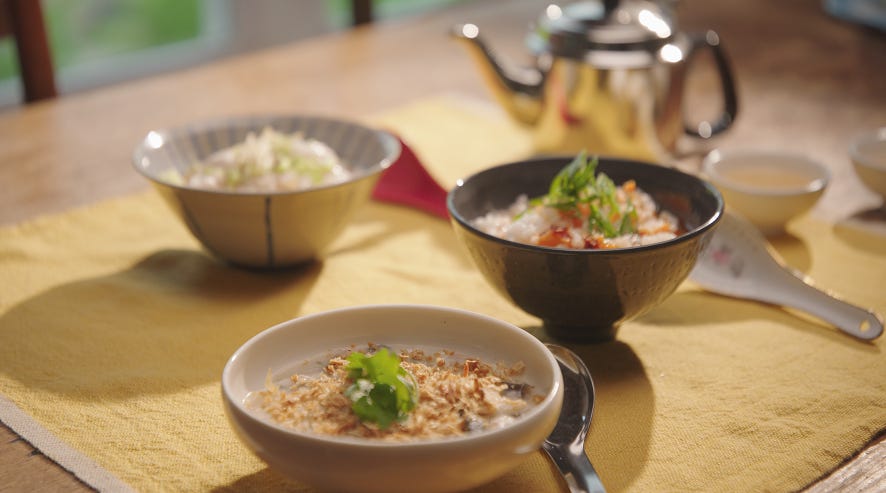
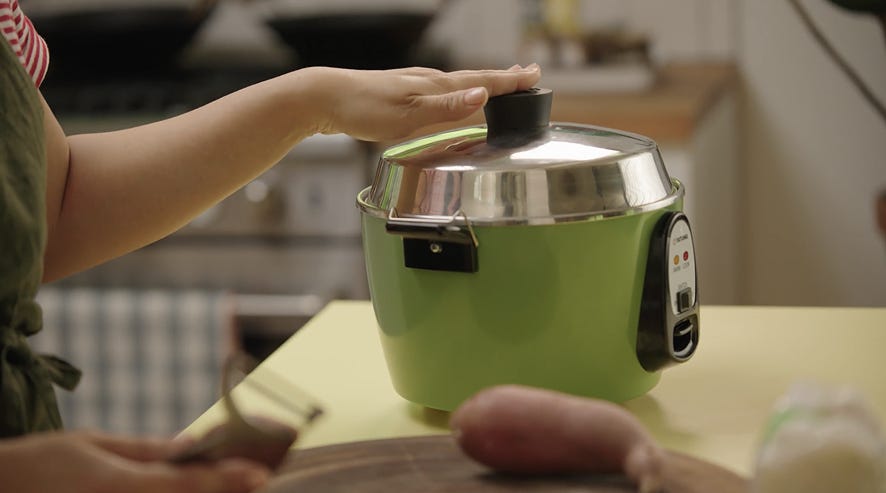
I prepare congee in a Tatung Electric Steamer, but you can also do so in a pot over the stovetop. These recipes are adapted from the Yun Hai Tatung Family Cookbook, and are all available online:
Ingredients and Equipment
I love to show off my collection of ceramics, props, everyday objects, and kitchen tools on the show, many of them gifted by friends or collected personally over the years. Here’s a little more information on what I used this episode.
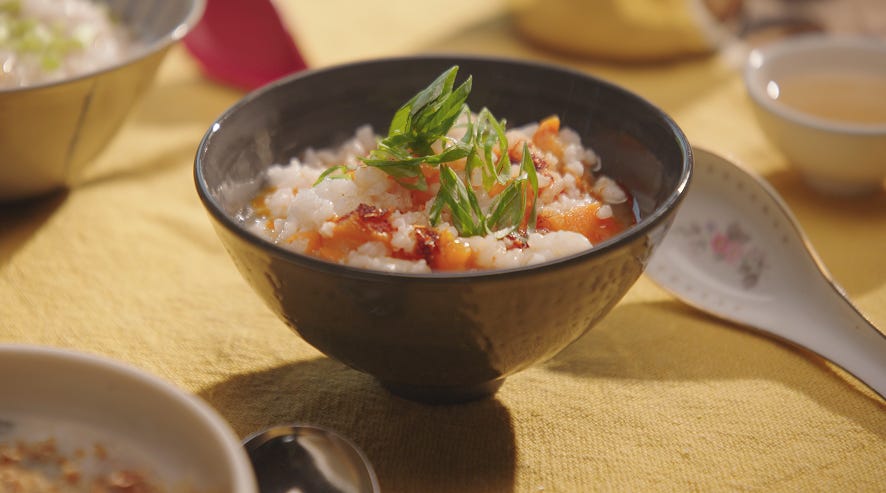
The brown serving bowl used for the sweet potato congee and the white serving bowl used for the century egg pork congee were made by my friend and ceramicist Matthew So.
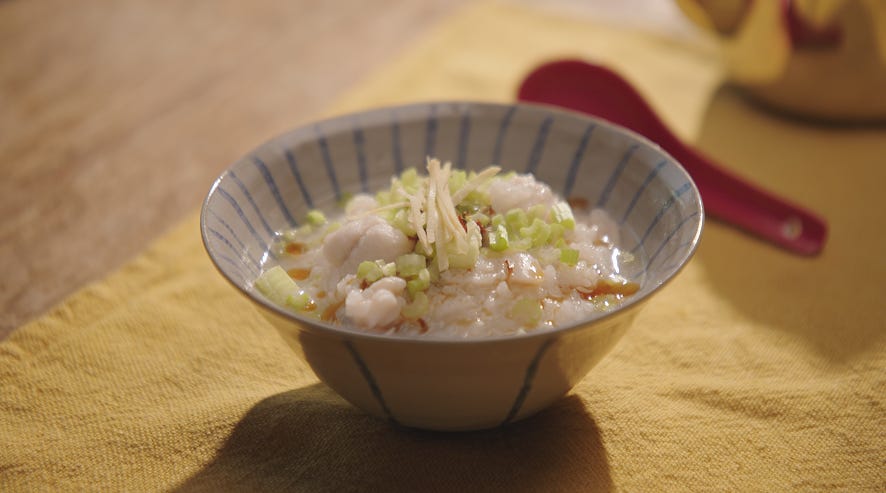
The gray and blue bowl used for the fish congee was made by my friend and ceramicist Debbie Carlos.
For the recipes, I chop the vegetables and the pork shoulder using our Maestro Wu Cleaver. I slice the fish using our Maestro Wu Fish Knife. I also switch between a round ironwood cutting board, which I purchased from an Asian grocery store in Detroit over 15 years ago, and a Material Kitchen cutting board. To cook the congee, I use the 6-cup Tatung Steamer.
And, for the recipes, we incorporated a few things from Yun Hai Shop, like our penglai short-grain rice, Amber River soy sauce, Su chili crisp mala, frizzled ginger in sesame oil, white sesame oil, frost salt, and fleur de sel.
Please reach out with any other questions on sourcing or ingredients. Happy to help, as always.
Gratitude and Acknowledgements
We couldn’t have done this without the support and passion of our friends and community. So much love and gratitude to Night Shift, who produced this, and all our creative collaborators for giving the show its unique voice.

Credits
Produced by Night Shift and Yun Hai
Made possible by Tatung Taiwan
Team:
Lisa Cheng Smith, host
Jessica Wang, guest talent
Jessie YuChen, food stylist & guest talent
Nicole Wang, culinary assistant
Amalissa Uytingco, culinary producer
Sam Broscoe, producer
Alec Sutherland, director & editor
Nathan Bailey, director of photography
Rob Woods, camera operator
Taylor Dekker, camera operator
Alexandra Egan, art director
Kyle Garvey, sound mixer
Jinho Myung, editor
R. Hollis Smith, mix
Rebecca Alexander, hair and makeup
Dustin Wong, music
O.OO, graphics
Jil Tai & Ben Hill, motion design and title sequence
Rachel Watson, behind-the-scenes photography
Our Set
Our set features props from Taiwanese, Taiwanese-American, and international friends worldwide, creating those Taiwancore vibes we love so much at Yun Hai.
Thank you for the beauty Mikey Chen, Lillian Li, Emilie Liu, Debbie Carlos, Matthew So, Kelli Cain, Material Kitchen, Mogutable, Felicia Liang, Sam Tilney, Lulu Yao Gioiello, Grace Jung, Eric Sze, Julianne Ahn, Alice Chai, Stephanie Smith, Rio Chen, and Leh Lin.
And much gratitude to our friends who contributed to wardrobe: Everybody World, Judi Rosen, Whimsy and Row, RMS Beauty, and Christine Mai Nguyen.
Special Thanks
Russell Wang, Maggie Chang, Shirley Liu, Ivan Wu, Feng Hsieh, Hollow, Chris, Leon, Simon, Agnes, Jim, Lillian Lin, Jasmine Huang, Natya Regensburger, Jeremy Hersh, Cat Yeh & the entire Yun Hai Team, our partners, and our community.
Before I Go
Lunar New Year is around the corner!
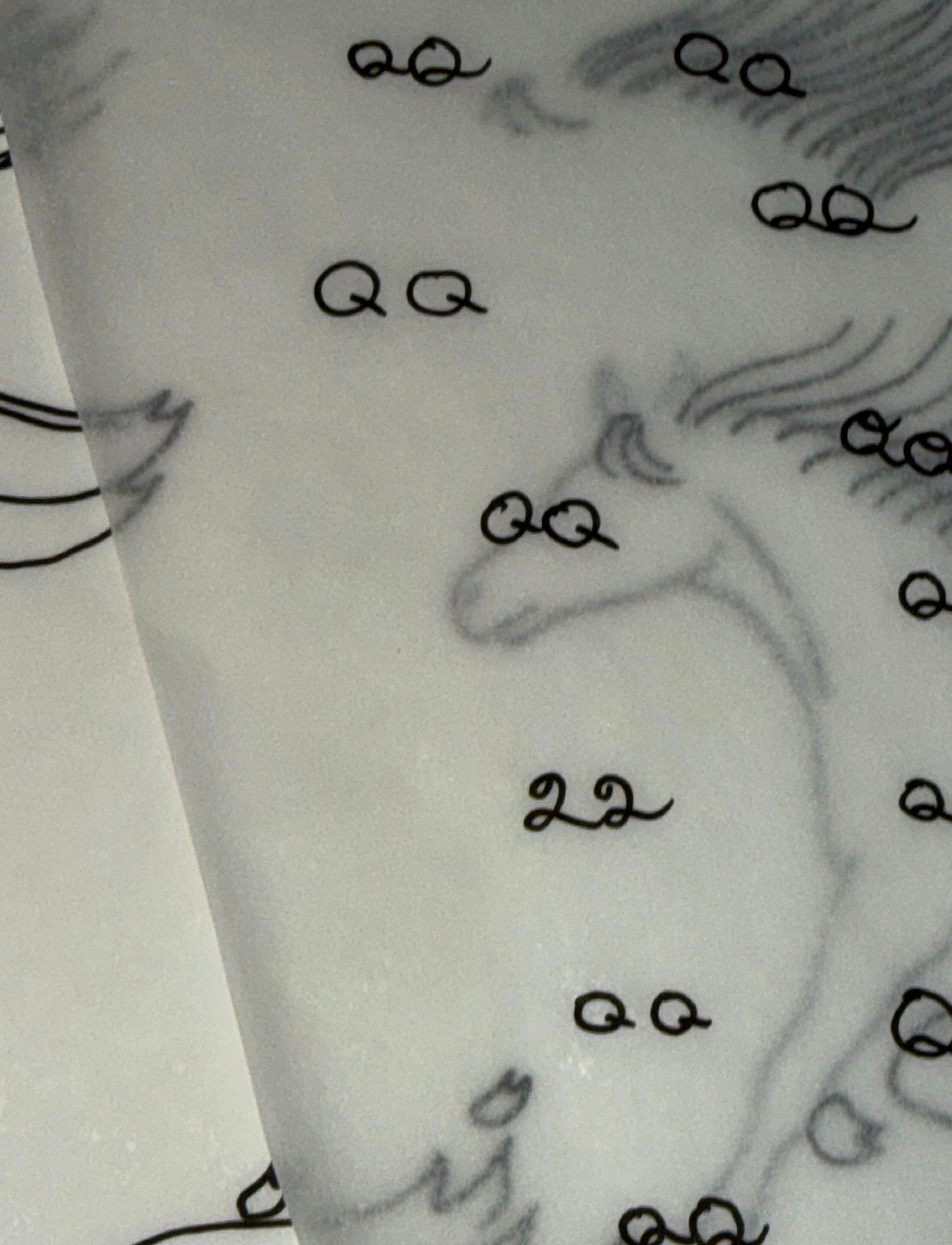
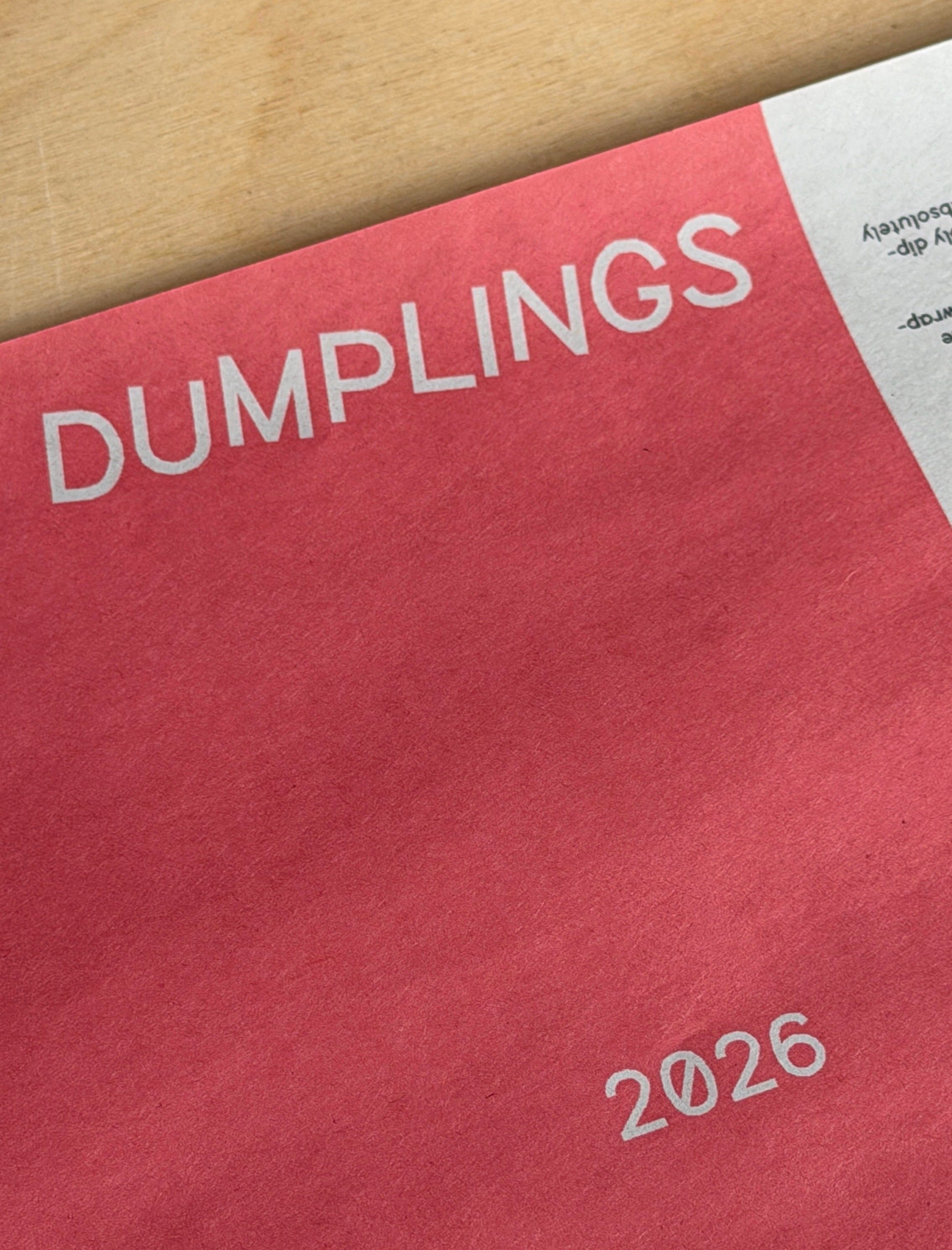
We’ve got a number of seasonal specials dropping in the next few weeks, including our QQ Horse merch (and a QQ snake redux); a seasonal restock of kumquat slices; red envelopes (next week); and a very special collaboration with Tiffany and Sean of Choochoo-Ca-Chew, one of the first Taiwanese recipe blogs I ever frequented. Stay tuned for a limited edition (free) dumpling zine featuring five of their recipes and an introduction to her new online dumpling course, The Dumpling Club.
And, for those patiently waiting, Emilie Liu’s Tiger God shirts should be back by early February, too.
Stay warm,
Lisa Cheng Smith 鄭衍莉
Written with editorial support by Amalissa Uytingco, Jasmine Huang, Grace Jung, and Lillian Lin. If you enjoyed this newsletter, please share it with friends and subscribe if you haven’t already. I email once a month, sometimes more, sometimes less. For more Taiwanese food, head to yunhai.shop, follow us on instagram and twitter, or view the newsletter archives.

Cooking With Steam S2E2: Preserved Radish Omelet with Cold Dressed Yuba Salad
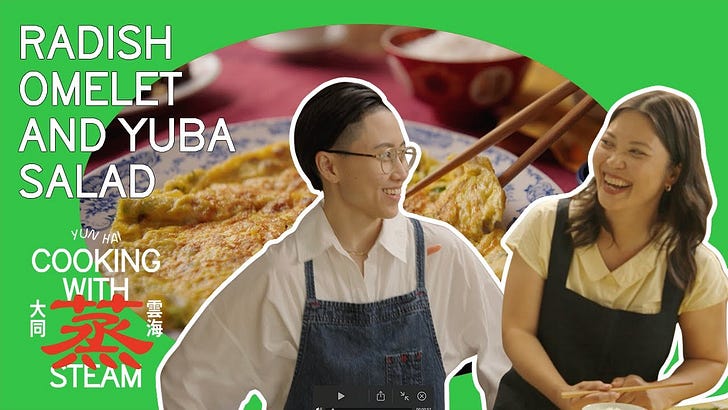
Taiwanese chef Jessie Yu Chen looks on while I mess up an omelet (momentarily).